Tuesday, 26 November 2013

The End Has Come


a reflection of series 8 as the show finally comes to a close


Despite eight years of tumultuous quality, ranging from unsurpassed heights to underwhelming lows, Dexter has always been one of my favourite television shows. One of the first television shows to feature a straight up mass murderer as its protagonist, Dexter offered something that was for a time unique. Unfortunately as the series went on it became apparent that Dexter had to grow beyond his emotionless, psychopathic behaviour in order for the show to remain fresh, and for this the writers cannot be faulted. However, as Dexter grew, his interest waned, we saw him tread the same path of self-discovery every season only to end up right where he started. But now, after eight seasons his dark journey is over, and for better or for worse, Dexter has finally ended . But was the ending worthy of such an intricate and crowd pleasing character such as Dexter? Or was it proof that this show really had outstayed its welcome?

Obviously this being a review of the series after it has concluded it goes without saying there are extensive spoilers, if you are still in the process of catching up you may want to shy away from reading this. You have been warned

Well for starters I just want to say that when I first saw the full trailer for this Season, I had something very different in mind. Based on what little footage offered, I predicted that, perhaps inevitably, Dexter's moral resolve would finally crumble and he would descend into the full blown psychopath we all believed lay just under the surface. In addition, based upon the events of the Season Seven finale it seemed that it would be the end for the relationship between our murderous anti-hero and his conflicted sibling, former lieutenant Debra Morgan (Jennifer Carpenter) as the guilt over what she did to protect her brother causes her to hurtle into a downward spiral of depression and chaos until she finally breaks and confesses all, effectively taking her brother down with her. Meaning that after having stayed so well hidden in the past what he "does in the dark will be brought to the light" (even the trailer's song hinted at such an outcome!)

This in itself would have been a deliciously complex finale that would focus not on the deranged serial killers that have plagued Dexter in the past, but instead would have been his final encore, brought about by the one person he believed he had real feelings for, a tragic sense of irony. However the trailer did make reference to two possible antagonists, a disturbed killer who 'scooped' out a portion of his victim's brain (particularly the part that gives a person empathy, and the mysterious Dr. Evelyn Vogel (Charlotte Rampling) who not only may have been a suspect of said murders, but would regardless be the perfect foil to Dexter due to her position as an expert on the psychopathic mind and who clearly has an agenda of her own, giving her the uncanny ability to seemingly know exactly how Dexter thinks, leading to the very real possibility that she may be the one to crack the mystery as to the 'Bay Harbour Butcher's' identity.

To get an idea of what I am talking about, and for those who haven't seen it already here is the Dexter Season 8 trailer.


To be fair, for the first three or four episodes that is what we got, less emphasis on the trademark 'Killer of the Week' scenario and more on the crumbling relationship between brother and sister as well as the breakdown of Dexter's 'moral' code. It was different, it was dark and to me it heralded the end of Dexter as we know it.

Alas it seemed that all this was too good to be true. The moment we found out Vogel's true connection to the Morgan family her interest slowly began to wane.As the prospect of her being the instrument of Dexter's destruction became less likely and instead we were greeted to a rendition of Mommy Dearest. Making Vogel the true mastermind behind the 'Code' isn't a bad thing in itself, in fact it allowed us to explore Dexter's origins in ways we have only dreamed about, from an academic standpoint. What made the story line rather lackluster was that it had very little to work along side with. The brain surgeon story line was abandoned at the Season's midpoint, only for it to be brought back for the last four episodes, when it was too late for it to make the same impact as say the 'Ice Truck Killer' (Christian Carmago), or the 'Trinity Killer' (John Lithgow) of Season's past. In addition the escalating discord between Deb and Dex was more or less resolved at about the same time, thus negating her as being the cause of his fall. Even the apparent loss of control for Dexter was resolved by the second episode. In a sense everything that made this season look so dark and exciting was resolved by the mid point, leaving the show to wander off aimlessly before hurtling back to its point for the series' concluding episode, unfortunately this resulted in the finale being a bang without a fuse, there was little groundwork for what actually happened until two thirds of the season had already been shown.

But every television show has problems, and these were not enough to stop me from tuning in each week to see how our favourite serial killer's story would end. There would positive elements to the season, Darri Ingolfsson made for a suitably creepy villain with Daniel Vogel, aka Oliver Saxon aka The Brain Surgeon, and interestingly one that served to be the exact polar opposite to Dexter himself. His link to Evelyn made for interesting viewing as these two killers, one her biological son, the other her spiritual one, both vied for her attention in a game of escalation and one-upmanship with tragic consequences. In addition the possibility of Dexter living happily ever after with his son and the newly returned Hannah Mckay was pleasant to see if not entirely satisfactory in terms of an ending. But I find it interesting to note that with so many possible scenarios for an ending in place, does the one they chose live up to the show's standards.

The answer, in my opinion, is that it could of...if handled better. After Vogel's grisly death put paid to the idea of her, through her tenuous alliance with her new-found son, playing a part in Dexter's ending and in effect allowing the narrative to come full circle and have her end a story that in many respects, as Dexter's creator, she began. We were instead granted a decidedly absurd episode full of loopholes and unlikely plot developments.

There were highlights of course, Deb's tragic death made for very sad viewing, she was the most conflicted of the show's central characters, even more so than her murderous brother. Despite now knowing that what he was doing all these years was of course wrong, and served to stand for everything she opposed during her time at Miami Metro, she nevertheless could not stand by and see her brother incaracerated and most likely executed. At the end of the day he was her family (her only remaining family) and the strength of that bond is what got her killed. But in my view this is where the episode began to falter. The distracting side plot about the cat and mouse chase between PI Elway and Hannah as he uses every means at his disposal to cash in the handsome reward for her capture, we saw Dexter behaving in such a way that managed to undo years of meticulous maintenance of his cover by simply stealing Deb's body from the hospital! I mean I know there was a hurricane on the way (Naturally) but come on! How would not one member of staff notice him casually taking her body out the hospital and down onto his boat.
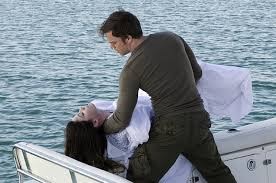

Perhaps I am being a tad harsh in picking on that so much, it was merely a means to an end, a way of getting Dexter into the middle of the stormy sea so that he can gently lay Debra's body in the ocean...and let her sink. Like with many of the decisions in this episode I understand the theory of it, but in practice it just seemed callous. His sister, the one person in his life that he had stuck with him through thick and thin just plonked into the ocean and allowed to sink, no better than his many victims! It was interesting to note however, that they chose to cloth her in white, a stark contrast from the black rubbish bags containing his usual prey. Perhaps it symbolised that despite her purity, despite her good nature, he still is ultimatly resposible for her tragic death. If this is the case then it is actually a very good idea, but one which looks better on paper. Similarly to how he simply rides off into the storm, to put himself at the same turbulent nature as the one that lies within him. Beautiful symbolism, slightly iffy execution.


I suppose I am just a touch bitter that very few of my hopes for the finale actually came true. The main villain suffered what was in my honest opinion, the worst death that a main antagonist on the show has done so yet. Considering that that this was the man that murdered his sister, there was no poigniant dialogue, none of Dexter's usual speech as he explains why he feels the need to do this. Arguably of course there is no need to explain, we know it already. But I must admit I liked the idea of Dexter getting emotional for the first time in one of his 'speeches' as he contemplates just who the victim was this time. Instead his very quick, very blunt, all in all rather rushed if you ask me, with no ramifications to DExter at all considering it was caught on police camera. To me it was amazing that no one discovered Dexter's identity, when he quite brutally ran a pen through Saxon's neck (in a prison cell) Batista and Quinn barely batted an eyelash. I suppose in hindsight the grisly death of one who has murdered one of your own is considered justice by some? I don't know, but what I do know is that it feels to me like a waste of a scenario. Dexter works in the Miami Metro so I always kind of assumed we would be in for a fantastic scene in which his friends and co-workers finally discover him for what he is. It would have been emotional, dark and above all narratively gratifying. Instead they allow him to simply walk away, understandable? Maybe, but in my opinion a tragic waste.

I know my review of the last episode may be considered brief, but I just wished to touch on the most important aspects, this review is more a critque of the season as a whole rather than just one episode. But the review would of course not be complete without a brief mention of the ending itself, the last scene, Dexter's goodbye. Let me just say that I would have been ok with Dexter simply disappearing into the storm, never to be seen again. There is a touch of darkness about it, as well as tragic irony, But most of all it adds a touch of ambiguity. Death may have been a bit much for a character we have come to love, but getting off scott free would have been a bit easy for him, so the ambiguity would have been a happy compromise. Ominous, yet hopeful.

Instead we are treated to the reveal that Dexter has simply become a Canadian Woodcutter...

Again the theory and logic are sound. Dexter must live with the knowledge that he ultimatly destroyed the life of the one person (besides his kind of pointless son) who actually meant anything to him. He must live with the knowledge that he must remain alone or risk hurting those around him, that he never will be 'human'. It's tragic, depressing and suitable and it would have worked well, if it hadn't reavealed he was a woodcutter, it is just too cliche! Even Wolverine has done it. If it had simply faded in to show him sitting at his table in his bare home, staring solemnly into the camera I would have been content with it, the look says everything, and while the show does end with that shot, what comes immediatly before takes much of the sadness out of it for me.


So quite clearly in my opinion the finale was an episode with plenty of sound ideas, and magnificent symbolism surrounding, but unfortunatly it did not quite manage to convey them well on the screen, a shame that such a great show had to end in such a mediocre manner. But I shall choose to remember Dexter during the glory days of Seasons one to four, and of course seven before Ray Stevenson left to film Thor 2.


Monday, 5 August 2013

'Doctor Who' finally begins to look his age.


From the youngest to the oldest, it is regeneration time again!


I have never really considered myself a die hard 'Doctor Who' fan, or a 'Whovian' as they are colloquially called. More a casual viewer who watches whenever possible and derives a mild sense of entertainment from the iconic British series. Yet last night I, along with most of the world it seems, eagerly awaited the announcement of the the latest incarnation of the near immortal 'Time Lord', currently played by Matt Smith in his eleventh form.

I must admit, despite him apparently being the bookies favourite, I never imagined them announcing 'The Thick of It' star Peter Capaldi as the as the latest actor to inhabit the 'TARDIS', preferring instead to pin my hopes on the likes of Bill Nighy or Tom Hiddleston. Despite this however, I am more than thrilled with the choice. As someone who has frequently criticised the ever decreasing age of the 'Doctor', seemingly as an attempt to cater to a younger generation of fans, the fact that Capaldi, who is at 55 the joint oldest actor to play the time travelling eccentric (along with original actor William Hartnell) is a gargantuan step in the right direction.

This is not to say that I have anything against current 'Doctor' Matt Smith, who I feel offers the best and most nuanced portrayal to date. In a role where with each regeneration requires not only a different appearance, but a different personality to match, it is important that each actor to take on the part brings something fresh, exciting and above all diverse to the table. Matt Smith definitely achieved this, he had a perfect blend of youth and age. As the series wore on his attitude increasingly became darker, that of a man who has lived too long and seen too much, and yet it is interesting to note that as his mind ages his body gets increasingly younger from 'Doctor' to 'Doctor'. Like Tennant he added a large amount of physicality to the role, using his body to great effect: Spinning, contorting, his movement was constantly erratic and it often made for very amusing viewing and contrasted nicely with the series' darker moments.

I highly doubt that Capaldi will engage in such antics, in fact I find it very hard to imagine what sort of 'Doctor' he will make, after watching 'The Thick of it' it is evident that he has fantastic comic timing, especially when utilising the sarcastic wit that made 'Malcolm Tucker' such a joy to watch, ergo fans need not worry the 'Doctor' will lose all sense of humour as he has done in the distant past. But at the same time I can imagine his portrayal being more somber than his predecessor, more world weary and aware of the consequences of his actions. After all if original continuity is anything to go by he bears the weight of being the last incarnation before he completes his cycle of regenerations and his body gives out for good, though I have no doubt Moffat will find away around that to ensure the series' longevity.

At the present one can only speculate what Peter Capaldi will bring to the role or how this choice will impact the direction the show takes current companion Clara, but with Capaldi being no stranger to the 'Whovian' universe, roles in 'Doctor Who: The Fires of Pompeii' and 'Torchwood: Children of Earth' I breath a sigh of relief to know
that the 'TARDIS' is in good hands.

Now all we need to see is his wardrobe!

Monday, 18 March 2013


The Dark Knight Return Part 2


The Dark Knight Returns...from retirement


Release Date: January 29, 2013
Director: Jay Oliva
Starring: Peter Weller, Michael Emerson, Mark Valley, David Selby
Plot: Following his defeat of the Mutant Leader, Batman faces his greatest challenge yet with the re-emergence of the Clown Prince of Crime who is more determined than ever to bring down the Dark Knight, and the Man of Steel who has been ordered to put and end to Batman's ever escalating campaign for justice.


It must seem a bit odd for me to write a review of a film which is actually a sequel, without having written about the first instalment, despite having seen it quite recently. But I have to admit, the only real reason that I watched the Dark Knight Returns Part 1, was so I could get to part 2. I am not in any way familiar with the Graphic Novel on which it is based but have heard innumerable good things about it from friends

The animated Batman films have always been amongst my favourite, I think they are able to capture the dark and gritty atmosphere in ways that Nolan's films, with the their sense of realism, are just not able to convey. Batman is a very Gothic character and that has never come across better than in animation. So now I will run you through the good points and the bad of the latest addition to DC animated canon.

When it comes to the voice acting of a Batman animated film, it is inevitable that people are going to compare the leading actors, more than likely unfavourably, with that of Batman: The Animated Series, in particular Kevin Conroy and Mark Hamill as the Dark Knight and Clown Prince of Crime respectively. This is not only unfair, but rather pointless as each actor tends to bring something new to the role and in all honesty the performances in this film were on the whole very good, with some being notably better than others. Peter Weller has one of the most distinctively weird voices in the whole acting game, and while I was at first put off by his deadpan drawl I have decided that this actually works to add an interesting layer to the character of Batman, it creates an image of a man who has seen too much, and lost so much more. It adds an element of weariness to the character which is befitting considering the vigilante had been retired for eight years before the events of the first film, it almost seems like he doesn't care as much anymore. But this changes when faced with the Joker, having known the Clown Prince of Crime was not to be trusted after his release from Arkham and still failing to prevent the deaths of dozens at his hands Batman finally considers doing what we all know he should have done so many years ago: Kill the Joker. In these scenes Weller imbues the Dark Knight with a menacing anger fantastically conveyed in his canyon deep growl. In many ways the story arc of Batman is similar to that of Christian Bale's interpretation of the character in the latter two instalments of Christopher Nolan's Dark Knight trilogy, but Weller manages something Bale never could, intimidation. Bale tried far too hard to be menacing and in doing so rendered himself almost unintelligible and earned a lot of criticism in doing so. But Peter Weller has a voice than makes you listen, and aside from the scene in which he delivers a speech to the Sons of Batman sat astride a horse in which he sounded quite flat, he is very commanding. Not as good as Kevin Conroy but a very fine substitute and one I would be happy to see reprise the role in the future.

The role which I was most anticipating however, was that of the Joker as it has been in every form of media containing him, from animation to live action. In the grand scheme of things Batman is quite a simple role to play, deep voiced, understated and with a slight growl of menace. Many actors have done a fine job of portraying the cape crusader. The Joker on the other hand is another story, very few actors have completely captures the right combination of horror and hilarity. It does not help of course that the character has changed in some way in pretty much every appearance to date, from crazed clown, to colourful mob boss, to flamboyant psychopath. When I heard Michael Emerson was going to take on this challenging role I was both excited and sceptical. I love Michael Emerson, he has a particular talent for the sinister and yet has been shown to display a level of comic timing on such shows as Person of Interest. But I had never heard him laugh and that is of course the most important feature of the Joker, it is his trademark. As I mentioned before I am unfamiliar with the Graphic Novel, so this most original take on Batman's arch-enemy surprised me a little bit. Camp, effeminate and on the whole a more subtle kind of maniac, it fits within the context of the narrative, the Joker like Batman is older and it seems in that time he has become less over the top cackling killer and more obsessive, sadistic and calculating. Of course that does not stop him from laughing as he guns down countless innocent victims all the while apologising “Excuse me, coming through, sorry, my bad” but it is much more understated and I think that makes him more sinister. I have heard a lot of critics complain that his voice sounds too nasally and weak to make an effective Joker but I disagree, I thought Emerson's voice was very chilling and suited this incarnation of the Joker perfectly. The only criticism I have was some of the laughter, it sounded too forced at times, the Joker's laugh should be organic, as it was with Mark Hamill and Heath Ledger, there were times that I thought Michael Emerson felt a little uncomfortable with it, but that is something that could be improved with further practice. I hope very much to see Emerson in future Batman adaptations.

I know I have spent a little too long discussing the main characters, but that is because I found the remainder of the supporting cast to be a little weak in comparison. In particular David Selby as Commissioner Gordon, he just had no authority to his voice and indeed he began to irritate me not long into the first film's runtime, luckily his role was heavily reduced in this instalment as the role of Commissioner is not held by Ellen Yindel voiced by Maria Canals, to her credit she wasn't bad, but I am undecided on whether or not she was good, I severely disliked her character but you are supposed to, she takes a decidedly different approach than Gordon of the Dark Knight, vowing instead that she will bring him to justice for the 'crimes' he has committed. While there was nothing wrong with her performance I also think sub-plots such as these take away from the main narrative elements by constantly inserting a scene in which Batman is forced to abandon his mission as he desperately tries to escape the ever growing arm of the law. I for one, would have preferred to have limited this in favour of some more screen time for The Joker and the antagonistic Man of Steel.

Speaking of which, I actually enjoyed the depiction of Superman in this film, Mark Valley voices the character with a clipped authority and an air of condescension which I think is actually quite appropriate for a near invincible alien superhero. In this film he is relegated to President Reagan's lapdog, destroying Russian fleets, deflecting nuclear missiles and hunting down the renegade Dark Knight. I imagine many fans not familiar with the graphic novel were disappointed with this new direction for the Man of Steel. But I love it! I do not think his half of the film is as good as the Joker's but when it comes to a physical confrontation Superman is the way to go. To watch this two iconic superheroes engage in such a brutal fight is probably a thing of beauty to those who always wondered who would win.

As far as the story goes, this film is easily better than the first. The first part was necessary of course but it also felt to be that it was merely the build up to this one. In this film Batman faces his greatest challenges as his return awakens his old foe from the state of catatonia that he had been in since Batman retired and it is quickly evident that his bloodlust and obsession for bringing about the end of the Dark Knight have been in no way dulled, what follows is a climactic confrontation which is filmed perfectly, I loved the idea of setting in a fairground (Yes I know this idea came from the Graphic Novel author, but I have never read it so I have to call it as I see it) what I loved most about this scene is that it shows you just how homicidal the Joker is in a way which we have rarely seen before in animation, not even Mark Hamill until he was allowed to run free in the Arkham game series. It was dark, it was brutal it was a perfect ending to the ongoing battle between the two. The imagery was distinctive and while the Joker's character may not be quite as memorable as those we have seen in recent years he is truly a monster.

But following this climactic chapter has concluded we realise Batman's troubles are far from over as the Powers that be have instructed Kal-El to bring an end to the Dark Knight's increasingly erratic campaign leading to a veritable clash of the titans in the streets as the two clash for supremacy which serves as the film's final, extravagant pay off and certainly ups the ante in terms of a physical challenge for Batman (The Joker having represented a more psychological and moral one). It all leads up to an ending that is both dark, featuring the death of a number of fan favourite characters, as well as with a glint of hope in the film's final seconds, the fact that all this action takes place amid a full scale riot further adds to the dramatic tension of the film. It is an animated film for a more mature audience who fully understand the Dark Knight and what he stands for. Above all else it is a fantastic story and one can easily see why Christopher Nolan turned to it for inspiration with the last part of his epic trilogy! Of course there were a few elements that I think could have been improved. I have never been a big fan of the character of Robin and this is no different, she is annoying and altogether pointless in my opinion. As was the cameo of Green Arrow, I do quite like the character since Arrow first premièred but this just felt forced, as if they brought him in simply to create a sense of continuity for the DC universe. The same goes for Selina Kyle, here depicted as obese and the owner of an escort service, while her scenes with the Joker were quite ominous and the hint that there has been an ongoing relationship between her and Bruce Wayne was a very nice touch. I'm not actually sure why he chose, after beating her, to dress her in a Wonder Woman costume...It's the wrong hero, it doesn't make much sense if you ask me!

But these minor grievances aside this is definitely one of the best Batman animated films since Batman Beyond: The Return of the Joker. It can easily hold its own against the likes of Batman: Under the Red Hood and in my opinion is far superior to the Dark Knight Rises, which while very good, gets a little worse each time I watch it. I would be quite happy to see this cast and production team return in the future, perhaps to adapt some of the more popular Graphic Novels? The Killing Joke perhaps? Or Death in the Family? Either way I think this may mark a new direction in DC animation, which while dramatically different from the immensely popular animated series, still remains a step in the right direction.

Monday, 11 March 2013


The Hobbit: An Unexpected Journey

Is the return to Middle Earth everything worth the wait for three new films?


Release Date: December 13, 2012
Director: Peter Jackson
Starring: Martin Freeman, Ian McKellen, Richard Armitage, Ken Stott, Andy Serkis, Graham McTavish
Plot: When thirteen dwarves and a curmudgeonly wizard arrive on Bilbo Baggins' doorstep little does he realise he is about to embark on an adventure which will pit him against hungry trolls, vengeful orcs, a deadly dragon, and a game of riddles that will shape not only his fate but that of Middle Earth itself.


I must admit I was filled with trepidation in the weeks before the release of The Hobbit. I was a fan of Peter Jackson's adaptation of the Lord of the Rings trilogy in 2001-2003 and I was very much looking forward to the Hobbit as in many ways I prefer the story. However, what was filling me with a sense of unease was his decision to turn it into another trilogy, two films I could understand, but when I found out that the reason behind this decision was that he intended to 'flesh out' the story and add narrative elements that were known to have happened in that period (as detailed in Unfinished Tales) but were not explicitly shown within the novel. In my honest opinion it seemed to be more about money and I thought such a thought process could lead to the ruination of something that Peter Jackson had worked so hard to achieve.

When I came out of the cinema I was divided. On the one hand the film was very good, which I was expecting, but on the other hand my fears were realised in so much that much of the additional content was not needed and served to only slow the film down upon repeated viewings. So now I shall proceed to discuss the good, the bad and the ugly of The Hobbit: An unexpected Journey.

The Lord of the Rings trilogy had a large ensemble cast of diverse and well developed characters, many of whom reappear in The Hobbit, and the vast majority of them are as equally interesting. Ian Mckellen shows that he is able to slip straight back into the role as a younger Gandalf the Grey. In fact there is very little point in discussing him at depth as he turns in virtually the same performance as last time albeit with more comedy in order to fit in with the overall tone of the film, it became increasingly apparent to me that this is the role for which I will always remember him. There is no doubt in my mind that it is Martin Freeman as Bilbo Baggins that deserves the most kudos. Admittedly it isn't hard to be a more likeable protagonist than Elijah Wood's overly whiny Frodo but he manages it with the charm and sharp wit that has become a trademark of Freeman's. Throughout the entire film Freeman manages to convincingly portray a younger version of Ian Holm's Bilbo that we saw in the Fellowship of the Ring yet without actually resorting to impersonation. This talent is best demonstrated in the 'Riddles in the Dark' segment which incidentally is the best scene in the film and features the ever increasing talent of Andy Serkis as Gollum, the two manage to play off one another in a manner which makes their dynamic far more entertaining than the one between Serkis and Elijah Wood. I believe that this scene alone is worth the price of admission and although I would not have expected a win, a nomination for best supporting actor would not have been entirely disagreeable for Serkis.

A large host of actors from the original trilogy also return to show how their characters got to where they are. Christopher Lee returns for a brief cameo to show that even before he was under the influence of Sauron he was still Middle Earth's largest tool, the look on Gandalf's face as Lee's melodic bass voice resonates from off screen conveys their relationship far better than any of the dialogue that follows. In addition, many fan favourites such as Elrond (Hugo Weaving) and Galadriel (Cate Blanchett) show up for a cameo featuring the fabled 'White Council' and the collection of acting powerhouses in this scene make up for the decidedly creepy CGI effects Jackson has incorporated to shave the years off his now ageing performers. My favourite function of this scene (in addition to the sense of nostalgia and seeing my favourite characters return) was the fact that it is placing the foundations for what I believe will be the best storyline in the trilogy: The banishment of the Necromancer (Benedict Cumberbatch) from Dol Guldor, which it would appear is being scheduled for the final instalment of the trilogy.

I mentioned briefly in my last paragraph the level of detail extended to the returning players from the Lord of the Rings, however, one aspect that I thought interesting was that this level of character development was not extend to the eleven dwarves that make up the bulk of the principle cast, in fact most of them I cannot even remember. The film chooses to focus on a select few, Thorin (Richard Armitage), Balin (Ken Stott), Dwalin (Graham McTavish), Fili (Dean O'Gorman), Kili (Aidan Turner) and Bofur (James Nesbitt) and the performances from each of these talented actors serve to elevate the character above their clichéd roles. Many of the other dwarves do not even get lines, for example, Bombur was only recognizable for his sizeable girth. This is somewhat surprising considering how distinctive and diverse the characters in Jackson's first trilogy are, though this may have been to differentiate the many races that make up the Fellowship of the Ring. Though if this was indeed the case surely measures should be taken to individualise an ensemble who all superficially look pretty much the same.

One new addition whom I absolutely loved (though a good friend of mine did not share my views on this) was Sylvester McCoy as Radagast the Brown, the third Istari wizard alongside Saruman and Gandalf. McCoy played the character as someone who has allowed the years of isolation to turn him into an eccentric, almost like the Willy Wonka of wizardry, slightly antisocial and more than a little peculiar in the company he keeps, choosing to shy away from his fellow Istari and instead devote his time to the wildlife of Middle Earth (I am actually 100% convinced his hair was matted with bird droppings from a nest he kept on his head). Considering the character's obvious affinity with all things nature it almost comes across as being a tad 'hippyish', in fact Saruman even makes reference to this when he claims that a lifelong addiction to 'mushrooms' has addled his brain and yellowed his teeth. He provides most of the more successful comic relief and rather nicely sets in motion the storyline regarding the Necromancer which I briefly touched upon previously. I hope very much that he will be utilised throughout this new series of films.

Regrettably, Like many directors before him I feel that Peter Jackson has finally succumbed to the over reliance on special effects, whereas the Orcs and Goblins in the original trilogy were all actors in decidedly realistic (considering what they are portraying) costumes this film instead chooses to create their villains using computer generated imagery and I personally feel that this removes something from the character, they just do not look real enough to be intimidating. This is best shown in new foe Azog, a character not featured in Tolkein's original book but has been added for the sole purpose of being a physical antagonist until Smaug is properly introduced in the next film. Although I was not a particular fan of this character, I do recognize the necessity for such a character but I felt he was a rather flat threat.

Visually the film was superlative, in fact I am rather surprised that the film was not nominated for any major awards this year, it was by far the best looking of the bunch. While the acting was never going to compete with the likes of Daniel Day-Lewis as President Lincoln or Hugh Jackman as Jean Valjean, it was a feast for the eyes in a way that no other film released in the last few months could hope to achieve. While I maintain that this time around there was far too much reliance of special effects the use of familiar set models as well as a host of new locations serve to almost ground the film in many ways, the landscape of New Zealand is still recognisable and it serves to almost ground the film in many respects. It was also exactly as I imagined the film to look, each character designed to perfection, even Thorin Oakenshield, whom I imagined to be much older looked better than I could have expected. It was an absolute joy to revisit such iconic sets such as Rivendell and the Shire. The moment I was greeted with the familiar sight of Bag End I could feel some of the magic that Peter Jackson first kindled inside me all those years ago.

Story wise An Unexpected Journey was always going to struggle a little bit, the film is not nearly as eventful as the Fellowship of the Ring and as such was inevitably going to drag a little bit, I have the feeling this is one of the primary reasons Jackson included so much 'original content' so to speak, but in doing this I believe he has taken some of the overall quality of the film! I am of the opinion that the Hobbit could have been made into two separate films instead of three and without including the sub-plot with Azog and the quality would have been maintained. Alas I fear the financial allure was too much for Jackson and co and in doing so he has sacrificed a portion of the story's artistic integrity for the sake of a dragged out narrative. However I will compromise in saying the film does an admirable job of setting the scene for the next two films which are undoubtedly going to be the money makers of this new franchise.

Admittedly this review does paint a rather grim picture of the film, this is not the case at all. The film was not as good as I was hoping it would be, but I do believe that it successfully paves the way for the following entries into this new trilogy, the Smaug teaser we were granted at the film's conclusion was enough to get me excited for the next entry. The quality of the next two instalments depends upon the quality of the foundations laid down by this film and in that respect it was successful. There is nothing inherently wrong with this film which has not been present in the vast majority of major blockbusters, and in many ways the film is very good. But from the man who brought us the Lord of the Rings, I just expected a little better.

Monday, 21 January 2013


Skyfall

At last Bond hits his mark


Release Date: October 26, 2012
Director: Same Mendes
Starring: Daniel Crag, Javier Bardem, Judi Dench, Ralph Fiennes, Ben Wishaw, Naomie Harris, Berenice Marlohe
Plot: After being injured in combat Bond must come back from the dead in order to fight an adverary with roots closer to home than he realises, one who will stop at nothing to destroy MI6 and 007's boss M for perceived past crimes.


When one thinks of British film and television, one can't help but immediately think of Harry Potter, Doctor Who and of course James Bond. The 007 franchise, like any other has had its ups and downs over the years. Most of these were largely solved when Daniel Craig took over the lead role, the campiness that had been increasing in recent years was largely removed as was the over reliance on increasingly fantastic and unrealistic gadgets. Instead 007 largely had to rely on his own wits and minimal fire power in order to save the day

Skyfall is the latest installment in this new breed of James Bond, following the rather disappointing (but still, in my opinion, underrated) Quantum of Solace and features a moodier more cynical James Bond . In order to distance itself from its less than well received predecessor it moves away from the Quantum storyline and instead focuses on an original storyline focusing more on Bond's superior M and the film flourishes for it as many people, including myself consider it to be one of the best entries in the 50 year run.

Daniel Craig turns in his best performance this time round, after being put out of action by one of his own allies he returns from 'death' bitter, out of shape and less compliant than ever, he is forced to undergo a rigorous fitness test and in doing so we are rewarded with the rarely seen site of Bond struggling, he isn't ready for the events of this film and as such he finds it that much harder. Throughout the film we are shown hints that Bond is passed his prime and that his time on the job is now limited. This is perhaps best demonstrated in a fantastically understated scene with Bonds new 'Q'uartermaster (ably played by Ben Wishaw) and again when Gareth Mallory (Ralph Fiennes) reminds 007 that this “is a young man's game”. It begins to show the potential for taking the series in new directions not seen before 007 is but a codename after all, Bond does not have to occupy it forever.

But as good as Craig was as the British super spy it is Javier Bardem's charismatic villain Raoul Silva that steals this show. Where Bond is understated Raoul Silva is over the top, he is rarely seen engaging in physical combat so it is hard to tell if he is truly Bond's equal but he is a new breed of villain, one for the modern ages, as is mentioned in my previous post. He is a computer hacker, arguably something far more dangerous than a mere megalomaniac. He doesn't hold the world to ransom under threat of nuclear strike, he doesn't want the world, he has a more personal agenda. Bardem imbues Silva with a delightful flamboyance that really makes him a joy to watch, though he doesn't appear until over an hour into the film and arguably that means that he isn't really developed as well as he could have been. He is first seen delivering a wonderfully disturbing story about rats before borderline sexually harassing 007, and this is one of those things which makes him so interesting, is he gay? Or is he just trying to unsettle our hero? Either way way it creates a dynamic between the two that continues until the film's dramatic conclusion.

While arguably there is no Bond girl in this film, well no main one anyway, neither of the other two could be describes as main characters. The closest thing this film has to a Bond girl is M herself! Promoted from instrument of exposition into full fledged main character, she has finally been fleshed out into a character we can all relate to...in theory, while I have no doubt this would work for most people, I just find the character a little bit too annoying to be tolerated as a field agent for the entire film. I have felt that way since the days of Bernard Lee and I still feel it now. Obviously I have nothing against Judi Dench, she is one of the best actors of our time but I think M is meant purely as a bureaucratic foil for 007 not as his sidekick.

The supporting characters are a blend of fantastic and mediocre as both of the supporting Bond Girls are bland and uninspiring, both are pretty yes but that is not the only requirement for a bond Girl anymore and neither are really that interesting. Even Naomie Harris, who is normally quite good as an actress, was only more slightly watchable as Bond's junior agent and soon to be series regular Even Moneypenny than Berenice Marlohe as the latest Bond 'squeeze' Severine who is uninteresting and underdeveloped, even compared to previous Bond Girls. Luckily neither of them are around long enough to bring the film down. On the plus side Ralph Fiennes, as per usual, delivers a stellar performance, this time as Gareth Mallory the droll liason between MI6 and the Government with more importance to the overall story than what it initially appears. But even Ralph Fiennes is overshadowed by Ben Wishaw who plays the new age Q. Since the early days I have always loved the scenes featuring Bond's quartermaster who was played by Desmond Llewlyn until his tragic death, and this new film is no different. Though now they have decided to bring Q into the 21st Century, gone is the cantankerous old man from previous installments and instead we are treated to a young nerd, who is barely older than I am. But it creates a fascinating dynamic between the two about Bond's increasing antiquity compared with Q's youthful, technological innovation.

Story wise the film seems fantastic on first glance, and it actually is, but the more times I have seen it the more problems I have with the narrative. For example, that rather intriguing storyline about Silva attempting to release the names of all undercover agents to the world is a plot line that could very well be the main focus of a film, but it is casually discarded after about fifty minutes in favour of the more traditional cat and mouse game between hero and villain. Which brings me onto my second criticism, throughout the film I couldn't help but draw many similarities between Raoul Silva and Heath Ledger's interpretation of the Joker in the Dark Knight, both always seem to be one step ahead of the protagonist, both seemingly get caught and incarcerated only to reveal it is where they wanted to be all along. However where Silva's character falls short is in his overall scheme. He goes to so much trouble hacking the MI6 system, stealing the names of those aforementioned agents to discredit both MI6 and M, as well as being purposefully detained before successfully taking Q's arrogance down a peg or two as he manipulates MI6's own computer system into releasing him...Only to walk into a crowded room and take potshots at M, it seems like so much effort for a rather minimal payoff. However this lack of sense is soon forgotten about when the narrative takes us to Scotland and to Bond's childhood home 'Skyfall' for a beautiful yet not overdone conclusion, Raoul Silva and Bond do not have a traditional final fight, they do not trade blows in some perilous location as has been done for fifty years previously, instead we are treated to something a bit more realistic (arguably) and indeed something which in my opinion is much more spectacular to watch culminating in one of the greatest tragedies in Bond history since his wife was murdered on her wedding day!


Overall the film is not without faults, but it still remains one of, if not the greatest entry into a series that has spanned fifty years and twenty three films. Through a more grizzled take on 007 and a flamboyantly memorable villain this film has breathed new life into a character who audiences, like the characters within the film had begun to question whether or not he still had a place in this world. I heartily recommend this film to everyone...even if it were for the fantastic opening song by Adele now the proud winner of a Golden Globe.

Monday, 3 December 2012

Top 10 James Bond Villains!


Bad has never been so good...


Bond season is upon us! With the newly released 'Skyfall' (which shall be reviewed shortly) James Bond has been put back on the map, certainly with me at any rate. Since viewing the film I have gone back and started the series from the beginning, and as such have decided to open the series of posts relating to Bond by counting down the top 10 Villains throughout the series 50 year run. The rule is that they must be the principal antagonists, they cannot be henchmen as a result this list will obviously exclude common favourites such as Oddjob and Jaws.

As an interesting side note, it was suggested to me that I compile a similar list relating to the bond Women, I chose not to for the simple reason is that I can't really stand any of them, for the vast majority of them their primary purpose seems to have innuendo ridden names and provide Bond with his 'reward' upon the missions conclusion. Obviously this not apply to every 'Bond girl' but there aren't enough exceptions to warrant earning their own list.

Without further ado let's start the list with number 10.


           10) Dr Julius No (Joseph Wiseman)
             
              Film: Dr No       

The titular Dr No will be forever remembered as the first Bond Villain, he set in motion a number of common characteristics that would remain a vital element of the Bond films forever more. Equipped with a pair of metallic hands which while granting him almost superhuman strength also severely limited his dexterity began the trend of having a villain which suffered from some form of bizarre physical deformity which sets them apart from 'normal' human beings. Joseph Wiseman manages to imbue the character with an arrogant sense of superiority and malice which would also become a Bond villain staple. Succinctly put in order to determine why Bond Villains are the way they are: calm, calculated and sadistically ruthless yet needlessly elaborate in their machinations for Bond's death you need look no further than Dr Julius No (I mean the tarantula, while successful in its attempts to create a tense and nerve racking scene, were almost certainly guaranteed to fail.) The only thing that doesn't put him further up this list is that his overall scheme, when compared to the later villains seems downright tame. I mean there isn't even any mention of a ransom or the idea of world domination. In fact the most significant contribution to the series, aside from the aforementioned villainous characteristics is to introduce the main antagonists of the Connery era films S.P.E.C.T.R.E.


         9) Mr Big/Dr Kananga (Yaphet Kotto)  
           
           Film: Live and Let Die      

'Live and Let Die' was a slightly unusual Bond film in so much that not only was it Roger Moore's first and as a result people had to get over the departure of Sean Connery, who even today is often considered the best Bond. But furthermore the entire roster of villains in this film are black, which has resulted in some viewers claiming that it is racist. Despite this minor controversy 'Live and Let Die' has managed to create one of the best villains in the series, even though he has the most ridiculous death out of them all, I mean being turned into a giant exploding blimp is just laughable. Up until that point however, Dr Kananga was one of my favourite villains, for three simple reasons 1) His plot revolving around the distribution of drugs seems much more believable than anything S.P.E.C.T.R.E had to offer, drugs are a very real problem in today's society, 2) The fact that Yaphet Kotto was able to convincingly play two people. Throughout the narrative we are let to believe that Mr Big, a crime lord encountered by Bond is simply an associate of Kananga's, he grows the drugs, Big distributes them, pretty simple. It was only about halfway through the film, and during a particularly tense interrogation that he pulls off his facial prosthetics and reveals that Kananga and Big are one and the same. In my opinion it was the biggest reveal since we saw what Blofeld look like...well the first one anyway. He was both sinister yet charismatic, chilling yet deadly Yaphet Kotto successfully managed to create an antagonist who almost managed to outshine the hero.


Sorry about this video, it wasn't the one I wanted but it really is the only one I could find. I hope to replace with a scene which better demonstrates the qualities I mentioned in my entry, this merely highlights his ridiculous death scene...still funny.

         8) Auric Goldfinger (Gert Frobe)     

           Film: Goldfinger    

There is not a single list that I have seen cataloguing the quality of Bond villains that does not include Auric Goldfinger. He is one of the most popular antagonists of the entire series, and quite rightly so. Though he falls into the category of being one of those villains who without his henchman would not really be difficult to overcome. Rather large around the middle and getting on in years he relies on the virtually indestructible Oddjob to handle the physical aspects of his plot. But it is his mind that make him one of the greats. His plot is rather interesting, he doesn't seek to destroy the world, or even rule it. He simply loves gold, as he says: He welcomes any enterprise that will increase his stock, his aim to detonate a nuclear bomb inside Fort Knox, thus irradiating America's gold supply and ergo increasing the value of his own. It is simple yet remarkably elegant and that is why it will always be remembered. Gert Frobe did a fantastic job in portraying Goldfiner, well the physical side anyway, like most early villains he was dubbed in the final film. But the subtle nuances and the deranged, yet oh so slightly bored look in his eyes which serves to convey his arrogance, he just doesn't have the time for anyone, deeming them irrelevant, are among Frobe's finest achievements in this film. Perhaps most importantly he will always be remembered for the infamous scene in which he has 007 strapped to a table and fires a slow moving laser up the centre of of legs in an attempt to bisect him. Excessive yes, but brilliant to watch and culminates in what I believe is the best example of Bond-villain banter:

007: Do you expect me to talk?
Goldfinger: (Laughs) No Mr Bond I expect you to die!


          7) Ernst Stavro Blofeld (Donald Pleasance, Telly Savalas, Charles Gray)

             Film: You Only Live Twice, On her Majesties Secret Service, Diamonds are Forever

Blofeld is arguably the most major villains of the series and certainly in Connery's films he is the main antagonist. But position 6 was a toss up between Blofeld and 'Thunderball's' villain Emilio Largo, while I think Largo was a better antagonist in his film than Pleasance, Savalas and Gray were in theirs but I chose Blofeld because he has had more of an impact on the series as a whole, he was the real mastermind behind the events of 'Dr No', 'From Russia with Love' and 'Thunderbal'l and in On Her Majesties Secret Service, in which he was played by Kojak actor Telly Savalas he even killed James Bond's wife, on their wedding day which left a lasting impression on 007, continuing even as he was played by the other actors, with Roger Moore visiting her grave. I always thought that the interesting thing about Blofeld was that his character was almost ruined by having to reveal his face. Prior to 'You Only Live Twice' Blofeld was shown only as a pair of hands stroking his signature white cat and wearing a signet ring adorned with the S.P.E.C.T.R.E logo, this was almost more sinister for me as, like many others, I have a slight fear of the unknown. As such, this faceless villain whom we knew nothing about was far more scary than any of the actors whose faces we have come to associate with Ernst Stavro Blofeld. Similarly the fact that he was played by different actors in each film where we saw his face, while in keeping with the novel's idea that Blofeld was in a sense, a chameleon who was able to alter his appearance as required (through surgery, prosthesis and disguise rather than shapeshifting), it does make it hard for us to like him because as soon as we begin to, he changes; and each incarnation bears little to no resemblance to the previous portrayal, whereas Donald Pleasance was creepy and subtle, Telly Savalas was brash and thuggish and the less said about Charles Gray the better. While he was unknown he was dangerous, mysterious and enigmatic but after they inevitably showed his face it just lost something important. This is why the clip below is not taken from the listed films and is in fact taken from my favourite Blofeld scene, before we knew who he was.


    6) Elliot Carver (Jonathan Pryce)      

      Film: Tomorrow Never Dies
Not many people like this villain. I suppose I can see why, Jonathan Pryce is hammy, melodramatic and the character isn't really all that threatening when compared with his fellow villains. But I like him because of his status a media mogul akin to News Corporation's Rupert Murdoch, and as a University Graduate in the subject of Journalism I can kind of appreciate the power that such a position holds and just plain love him the way I loved my subject, so this one is more personal. I love the power that the Media can have, as is evidenced in Carver's introductory scene where he simultaneously manages to blackmail the American President using footage of him involved in sordid activities and frame the Chinese for the murder of British naval soldiers in order to start World War Three simply so that he can have broadcasting rights. It is a much more realistic form of world domination than holding the world to ransom under threat of nuclear strike. In today's world information is the true weapon and those who own our news outlets are the true holders of power and their web of influence is vast and impressive which is shown in the scene below, a resourceful journalist can find information anywhere provided they look hard enough and someone with a contact web as wide as Carver's is undoubtedly a force to be reckoned with. Furthermore, this character represents the corruption that is rife in our media which was brought to light in the recent Leveson Inquiries and as such is a sort of parody, even if it was not quite so noticeable at the time of the film's release. As I said, it was not Jonathan Pryce's performance that made this character the villain he was, his dialogue was hammy and the performance matches it on every level. But in terms of power arguably Carver is the most powerful enemy Bond has faced...and he also has a magnificent death scene.


    5) Alec Trevalyan (Sean Bean)          
            Film: Goldeneye

The best villains are often those who used to be friends, just take a look at Professor Xavier and Magneto! The same is true with James Bond and Alec Trevalyan, or as he was known until his defection: 006. The fact that they were once allies and even close friends makes the betrayal and ultimate defection of 006 even more dramatic. In addition this means that he has received exactly the same training as Bond himself resulting in the first even matched physical confrontation Bond has ever encountered from a main villain, until this point the final battle as always been a little bit silly, with Bond easily overpowering his hilariously outmatched adversary without any sort of effort whatsoever but this was the first film in which Bond himself was as bloody and beaten as his antagonist. It makes for a much more engaging film because in a sense it means that the villain is essentially Bond himself, or rather how Bond could have turned out, they are two sides of the same coin. This makes for a particularly amusing scene in which Trevalyan is able to disarm 007's carefully planted explosives because they both wear the same Q Branch issued wristwatches containing the detonator. In many ways he knows Bond's moves before he does, quicker even as he himself states that he was 'always better'. Most of 007's enemies have been intellectually brilliant if a tad unstable, but 006 sets himself apart because he was the first to show us just how dangerous MI6 training could be if given to the wrong person, a theme utilised again for latest villain Raoul Silva. But perhaps the most important thing about Alec Trevalyan which makes him worthy of an appearance on my top 10 list...he was played by Sean Bean, and anything played by Sean Bean is immediately imbued with the same sense of 'badassery' that the actor himself possesses.


          4) Franz Sanchez (Robert Davi)                                   

            Film: License to Kill

I imagine that there were a lot of other villains who could have achieved Sanchez's level of evil if only their respective films had been granted the same benefits his film, 'License to Kill' had. Being the first Bond film to receive a 15 certificate rating meant that they could get away with a lot more than they had been been up until that point, and as a result the reason why Franz Sanchez makes it so high up on my list is because of his actions, the most despicable involving a certain CIA agent by the name of Leiter, who after many years of being Bond's primary American ally and counterpart was unceremoniously deprived of his legs after being lowered into a shark tank while his new bride was raped and murdered. Leiter was later left to be found by Bond with a note tied round his neck with the chilling message 'he disagreed with something that ate him'. This was new territory for Bond, and was one of the many controversial elements surrounding that particular film. Even the casual mass murder committed by Max Zorin didn't compare to that. Despite the fact that I said it was these acts which had him placed so high on this list, it also prevented him from climbing any higher. Most Bond villains, despite their evil nature were at least likeable and charismatic. Sanchez was much more realistic and that made him just a tad too unnerving. Once again his plot had nothing to do with world domination, he was a drug dealer. In fact he may be the only villain who was hunted for Bond purely for revenge as opposed to being sent their to prevent world domination. Robert Davi made Sanchez charismatic but also vile meaning that perhaps for the first time most fans couldn't wait to see his inevitable demise, which when it does come around is presented in such a way that we feel the victory as much as Bond does, Leiter has appeared in enough films before 'License to Kill' that we have become to accept and enjoy his presence, to see bond enact such brutal vengeance is as satisfying for us as it is for him.


            3) Francisco Scaramanga (Christopher Lee)                

              Film: The Man with the Golden Gun

Scaramanga deserves to be on this list simply because he is played by Christopher Lee, who is my absolute hero. But while Scaramanga is truly a brilliant antagonist the plot of his film 'The Man with the Golden Gun' just doesn't allow him to surge to the top of my list, he isn't really given an awful lot to do. However the scenes in which he does appear are far and away the best in the film. What is interesting about him is that he seems to be the first villain who is presented as being 'the dark side of Bond' he is as suave and sophisticated as he is and perhaps even more deadly and has the distinction of being the first Bond Villain to have a genuine girlfriend, even if she is terrified of him. Christopher Lee plays the character as he has played most of the characters in his forty plus year career, elegantly evil, demonstrated perfectly in a scene with Bond while sat ringside of a kickboxing match when he tells him of how, when working for a circus, he shot the trainer of an elephant he had befriended for animal cruelty and says calmly: “I always thought I liked animals, then I discovered that I liked killing people even more”. In addition managing to shoot someone so that they do not even fall or slump from their seat is quite a feat in marksmanship and is just one of many indications of just how lethal this man can really be. It is interesting to note that Scaramanga effectively begins the film as another villain's henchman, like Rosa Klebb in 'From Russia with Love' being second in command to the real villain Blofeld, Scaramanga is on the payroll of Hai Fat a businessman who seeks the film's object of interest, the Solex Agitator. But unlike Klebb, Scaramanga quickly tires of being mistreated and coldly kills his employer, taking his assets and the Agitator for himself. However, the thing that makes this film truly memorable is Scaramanga's funhouse; in order to keep him on form Scaramanga has an arrangement with his ludicrous henchman Nick Nack, he brings assassins to the island in attempt to kill him, but first he must lure them to the funhouse a series of elaborate traps and optical illusions designed to force Scaramanga to focus his senses to overcome his adversary while it causes them to become disorientated and paranoid. When Bond is lured inside it results in what can only be described as the most inventive final fight the series has ever seen.


          2) Max Zorin (Christopher Walken)             

            Film: A View to a Kill

Many argue that 'A View to a Kill' is one of the worst Bond films, Roger Moore was, at this point, far too old to play the role of 007 and looked ridiculous when paired with the youthful Tanya Roberts. But of the many problems this film has Christopher Walken's decidedly unhinged portrayal of psychotic businessman Max Zorin was not one of them! A genetic experiment gone wrong Zorin is both brilliant yet intensely homicidal and if you have seen 80% of films featuring Walken you will know this this is exactly what he specialises in. Unlike most villains, who while being undoubtedly psychotic rarely get blood on their own hands but tend to find inventive ways of avoiding it, from henchmen to traps, Zorin loves to kill people and does so frequently shown perfectly in a scene towards the film's climax in which he not only guns down most of his henchmen in cold blood, but does so while laughing hysterically. It was a kind of evil which had not yet been seen, it wasn't brilliant it was just monstrous. It was the sadistic glee that Zorin took from killing that set him apart from previous villains and made him so memorable which I suppose is a good thing considering the low quality of his henchmen, yes I know May Day was physically capable but she was just so annoying that I try to forget her and focus on Zorin. In some respects he reminds me a little bit of Heath Ledger's Joker, he desired nothing more than continue with his crimes and killing regardless of any cost to himself. During their final confrontation on the Golden Gate Bridge after viciously attacking Bond with an axe and faced with the prospect of falling to his doom he simply cackles manically before slipping from the bridge and into the depths below. The unhinged quality that Walken gave in his performance will forever put him a notch above most villains who, in hindsight, were really all talk. Zorin was a psychotic monster who just loved to kill and that makes him one of the most dangerous foes Bond has encountered yet. Finally he delivered one of the best lines of dialogue in any film I have seen, and they are words I have tried to live by:

“Intuitive improvisation, is the key to genius”


           1) Raoul Silva (Javier Bardem)                  

             Film: Skyfall

Raoul Silva is the latest addition to fifty years worth of Bond Villains, what distinguishes him from he fellow evil doers is that he is a cyber terrorist, all of his plans are carried out using high powered computers, this type of villain has been seen before in the form of Boris Grishenko in 'Goldeneye' but has now been upgraded to primary antagonist and in doing so has shown audiences that Bond has been brought into the present, there are no more megalomaniacs stroking cats and plotting world domination, there are just technological geniuses who are able to access whatever information they want and use it to do what no other Bond villain has ever done, bring both MI6 and its icy leader to their knees. Javier Bardem did wonderful things with Silva, after seeing the film I realised that there was not one element of his performance that I expected, after seeing the released image of him dressed as a police man I couldn't help but liken him to Red Grant in 'From Russia With Love': Tall, blonde and physically intimidating. However not only do you never see Silva engage in a physical fight, he was incredibly camp and was quite possibly the only bi-sexual character in Bond's history. I say possibly because it was never actually confirmed, while he did appear to have a particular interest in Bond, I was given the impression that he merely did it to make him uncomfortable, intimately caressing him all the while asking him to try and remember how his training could help him, it seemed a little too sadistic to be genuine. Furthermore the camp affectations Bardem gave his character reminded me slightly, like Zorin before him, of the eccentricities of Heath Ledger's Joker . He was just excitable, enjoying his work and simply having a good time causing so much chaos. He is the only Bond Villain to have actually given me chills as he walks around Bond's Scottish estate calmly throwing incendiary grenades through the windows. Or when he holds the gun to M's head in the film's dramatic conclusion. In fact one could make many comparisons between Silva and the Joker, his plan may seems overly elaborate, years in the making, only for him to walk into a courtroom and open fire much like the clown prince of crime going to all that effort, just to cause a little anarchy. But upon a second viewing I kind of got the impression he was doing it just because he thought it would be fun. He was a positive departure from the Quantum organisation that has been the main focus of Daniel Craig's Bond film, and I hope for more like him in the future.


And there we have it, I know it took a while. But I've had extra hours at work and University assignments to hand it so it has put me a little behind, I hope you enjoyed this and stay tuned for part 2 of my own personal Bond Season.